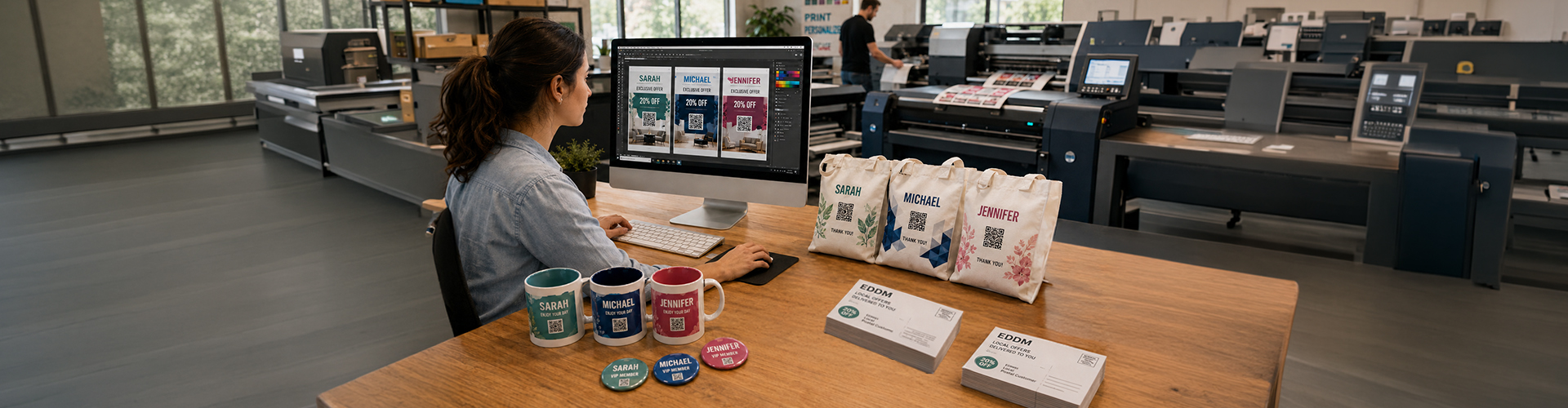
Why do promotional products no longer have the same effect as before?
Over the years, the promotional product marketing was based on volumes and visibility. Companies sent the same number of postcards, letters, labels, and branded objects in large quantities, hoping that repetition would prompt recall.
That will not work once the cost of attention is high and competition is elevated. Nowadays, it is yielding declining returns. The transition is not about abandoning print or promotional products. It is one of the ways to make them more relevant.
Variable data printing has become a vital enabler of this shift, enabling promotional product marketing to focus on delivering meaning rather than mass distribution without
efficiency loss.
What Is Variable Data Printing, and What Is its Importance Today?
Variable data printing (VDP) is a digital printing technique in which text, images, graphics, or even offers can be printed differently on each piece without slowing the printing process. The Data and Marketing
The Direct Marketing Association (DMA) states that personalized direct mail can achieve response rates up to 5-6 times higher than non-personalized mail when relevance is appropriately applied. This level of customization is operationally feasible
at scale using variable-data printing.
The only thing that makes VDP particularly relevant today is one of necessity rather than novelty. Buyers expect relevance. Generic promotional products are becoming less visible.
On a fundamental level, the digital printing variable data allow the following :
- Customized names, addresses, or offers on printed materials.
- Real-time segmentation-based messaging without printing.
- Customization of postcards and letters, as well as labels and packaging.
This is one of the capabilities that will directly influence the performance of promotional products in competitive markets.
What Does Variable Data Printing Do in a Promotional Campaign?
The data printing process is not design-based. Variable data printing software combines customer or prospect information with creative templates.
Regulations govern the nature of the text, images, or offers, which are modified according to pre-established parameters, including geography, purchase history, or customer type. Operationally, it is as follows :
- There are unique outputs that can be generated based on a single print file. Digital presses are considered variable-data printers, in which content is altered on the fly.
- The speed of production is the same as opposed to the traditional offset customization.
This is one reason why direct mail, labels, postcards, and promotional inserts are being printed with variable data printing and why personalization drives direct response.
Why Is Variable Data Printing Changing Promotional Product Marketing?

Promotional products succeed when they feel intentional. Variable data printing enables that intention to scale.
Promotional products succeed when they feel intentional. Variable data printing enables that intention to scale.
In promotional products marketing, VDP enables :
- Personalized postcards promoting location-specific offers.
- Variable data letter printing that references prior interactions.
- Variable data label printing for packaging that adapts by region or buyer segment.
This shift transforms promotional products from branded reminders into relevant touchpoints.
What are the true advantages of Variable Data Printing to Marketers?
Variable data printing does not just bring up personalization. The advantages of variable data printing on a performance basis are the following :
- More relevant, increased response rates.
- Segmented messaging yields a better attribution.
- Better ROI with no growth in print volume.
- Accelerated campaign optimization.
In variable-data postcard printing, marketers can test offers on the same mailing to different segments. In the long term, this enhances decision-making without increasing production complexity. These benefits justify why variable-data printing solutions
have become the norm in contemporary direct-mail plans.
What are the Applications of Variable Data printing on the Various Promotional Products?
VDP does not require postcards or letters. Its effect cuts across the board on promotional forms. Typical applications include alterable data printing on business cards with individual URLs or QR codes.
- Variable data letter Postcards that tailor the message by area or target demographic.
- Letter printing with variable data on account or loyalty campaigns.
- Flexible data label printing of packages and compliance-based companies.
In packaging, variable data printing is becoming increasingly important, enabling brands to distinctly identify limited production, regional packaging, or compliance labels through personalization.
What is the role of Variable Data Printing Companies and Providers?
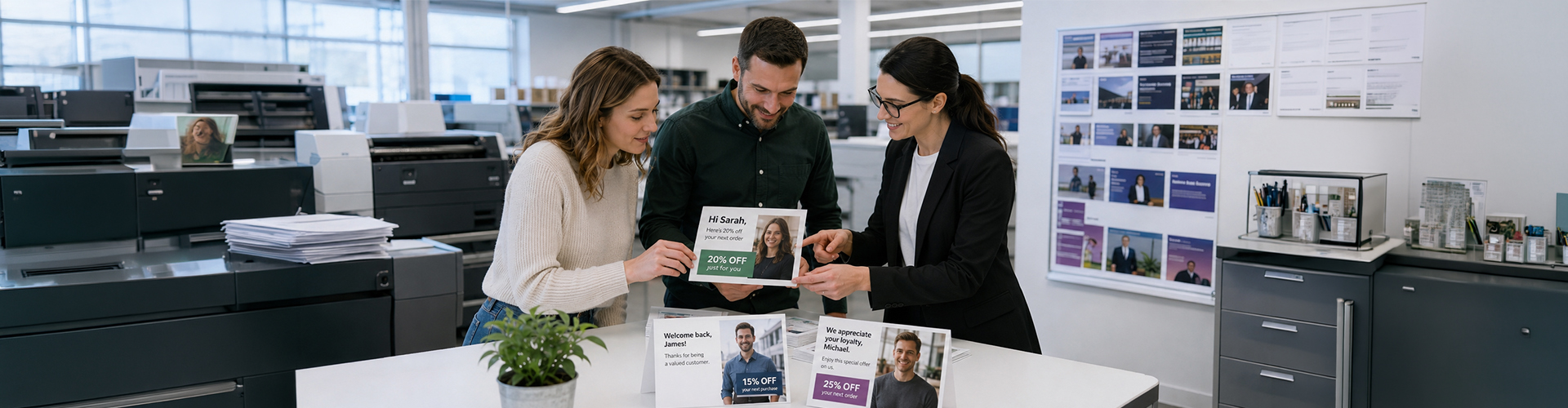
The effective implementation of VDP involves data, design, and production. Variable data printing service providers and companies can be seen as integrators that ensure data accuracy, creative logic, and print execution are all on
the same page. Inaccuracies in data reasoning may destroy even the most complex campaign. Variable data printing providers that are reliable usually support :
- Data hygiene and validation.
- Version control and template logic.
- CRM/marketing database integration.
- Digital presses allow scalability of production.
The decision of identifying the appropriate variable printing company is usually what separates a smoothly scaled campaign from one that stalls.
What Is the Current Market of Variable Data Printing?
This is because the data printing market, which includes variable data printing, keeps growing as personalization is now a minimum.
Smithers' print market research indicated that, with demand for shorter runs, customization, and turnaround time, digital printing with its variable-data applications is still increasing faster than traditional print segments.
This expansion is indicative of a larger change in marketing: now, relevance is more important than reach.
With the development of variable data printing technology, an increasing number of businesses are incorporating VDP into the heart of their marketing processes, rather than viewing it as a high-value-added component.
How Has Variable Data Printing Technology Evolved Over Time?
The history of variable data printing is closely tied to advances in digital presses and data processing.
Early VDP applications were limited by software complexity and production speed. Modern variable-data printing technology companies
have removed many of these constraints through improved processing power, more powerful RIP engines, and advanced workflow automation.
Today’s best variable data printing software allows complex personalization rules without manual intervention, making VDP accessible even for mid-sized campaigns.
This evolution has made VDP practical for everyday promotional products, not just enterprise-level mailings.
How Can Businesses Set Up Variable Data Printing Effectively?
Understanding how to set up variable data printing requires more than purchasing software.
Successful implementation depends on :
- Clean, structured data.
- Clear segmentation logic.
- Flexible creative templates.
- Alignment between marketing and print teams.
Without these foundations, even advanced variable data printing services fail to deliver meaningful results.
Organizations that treat VDP as a system rather than a feature see better long-term performance.
What Does the Future of Variable Data Printing in Promotional Marketing Hold?
Variable data printing is out of the lab and into the field. It is becoming foundational. VDP will be more supportive as promotional products marketing advances, as it
will be more supportive of the following :
- Account-based marketing strategies.
- B2B personalized packaging.
- Combined physical and online attribution.
- Data-driven and more predictive personalization.
For direct mail and print service providers, VDP is both a blessing and a task. Relevance is enabled by technology, whereas success is enabled by strategy.
How Variable Data Printing Is Redefining Promotional Products Marketing
Dynamic data printing alters the costs of personalization. It enables the marketer to provide relevance without compromising on efficiency. In direct mail, packaging, and promotional products, VDP converts fixed print to dynamic communication.
Companies that embrace it intelligently achieve greater engagement, improved measurement, and higher ROI. Relevance is no longer a choice in a world where attention is scarce.
Direct mail services through variable data printing are redefining value creation by promotional products and how print can compete in an era of personalization.